News

Twenty-Four Hours After a Single Blow
A case study of media coverage and algorithmic distribution
Monitoring period: 28 September 2026, 18:00 – 30 September 2026, 00:00
On the evening of 28 September 2026, the Kreni-Promeni movement posted on Instagram that Aleksandar Šapić, Mayor of Belgrade, had physically attacked Tatjana Mićić, a councillor for the movement, in Bežanijska kosa. The post included a video statement by the councillor, whose face was bloodied, and said that a medical examination had found a fracture to the left nasal bone and part of the upper jaw. The following day, the Third Basic Public Prosecution Office issued a statement saying that the people injured had sustained minor injuries, and that Mićić had been referred to a maxillofacial surgeon to assess the extent of her injuries. Šapić denied hitting the councillor, saying he had only pushed her away while defending himself from her husband.
This analysis traces the lifecycle of the story from its first appearance to the end of the monitoring period. It covers 181 articles published by 22 news websites, as well as content delivered on social media (X, Instagram and TikTok). It examines how information about the incident was selected, shaped and circulated under the influence of different sources, reactions and editorial decisions.
The main finding is that the media narrative shifted significantly the day after the incident. This was driven not by subsequent edits to published articles – unusually many of which were made without any note to readers – nor by statements from the people directly involved, but primarily by public statements from the prosecutor’s office and Aleksandar Vučić, the head of the Serbian Progressive Party’s electoral list.
Nine of the 22 news websites did not quote Tatjana Mićić at all, and eight did not name her injuries. Her husband, whose alleged role in the incident is central to Šapić’s defence, is mentioned in 44 articles across 17 sites but is not quoted in any of them.
The analysis examines four related questions: how quickly the story reached different newsrooms; what words were used to describe the same incident; who was given the chance to speak and be quoted; and how the content and framing changed over the course of the day. We also analysed social media content to see whether users received the same basic information or political interpretations of it. The findings do not prove how any individual algorithm works; they record the content delivered during the sessions monitored.
Media coverage
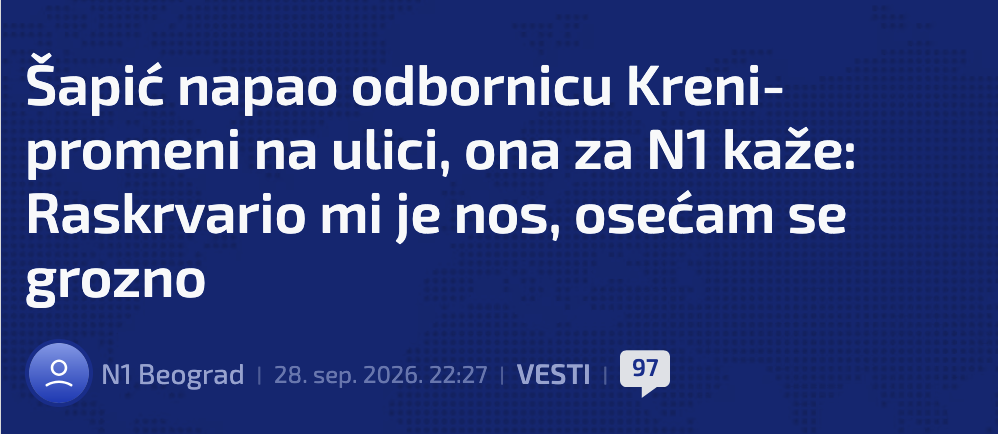
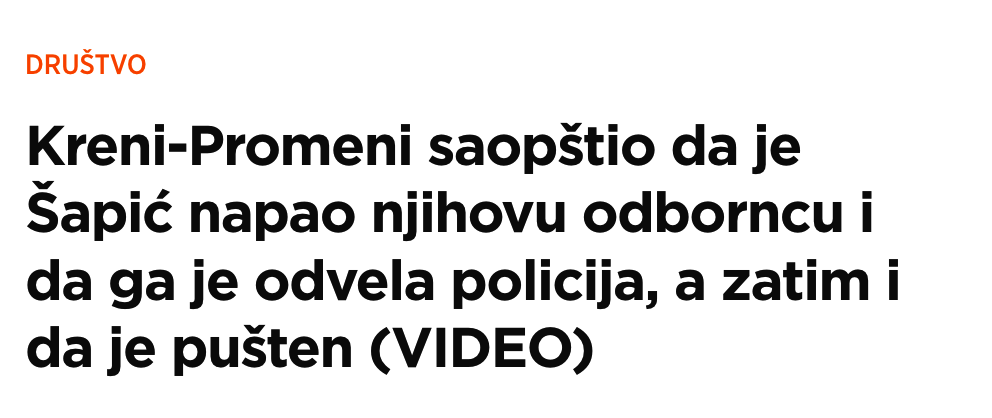
Nova published the first article at 22:10, followed by N1 at 22:27, Insajder at 22:39, Blic at 22:40, 021 at 22:43 and Vreme at 22:57. These first articles reported an attack and a broken nose. After Šapić issued a statement, pro-government sites published their first articles between 23:25 and 23:41, mostly repeating his account that he had pushed her away in self-defence.
Timeline
Phase I: 28 September, 21:46–23:00The attack is reported and the first wave of coverage
ShowHide 8 events
The attack is reported and the first wave of coverage
ShowHide 8 events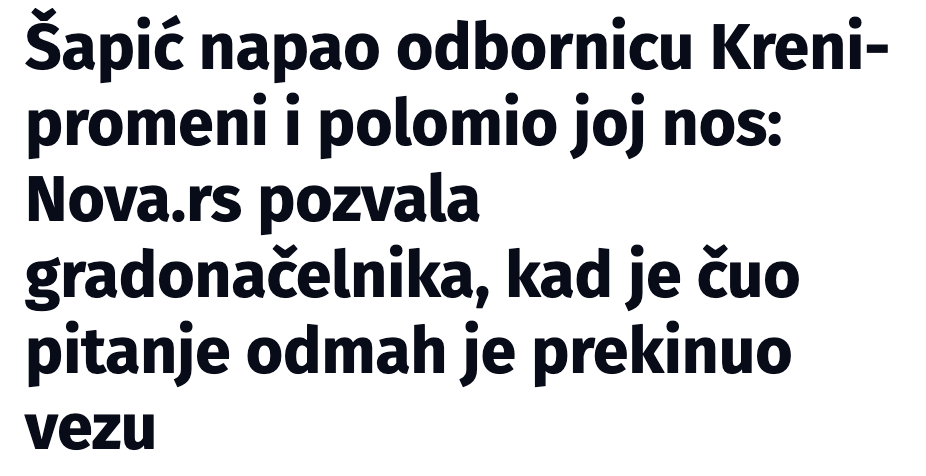
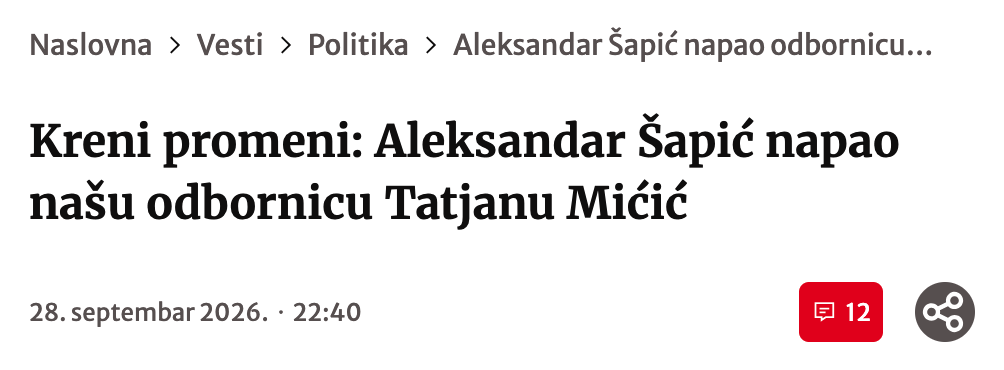
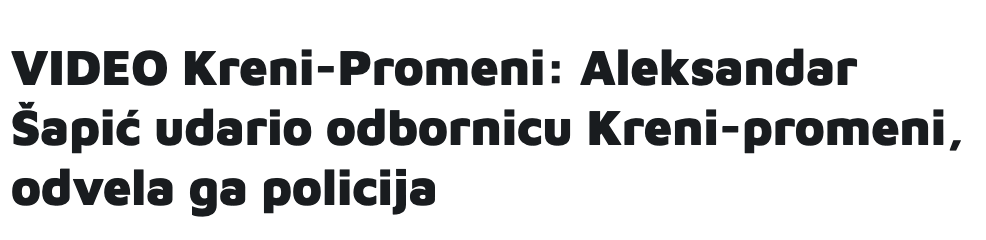
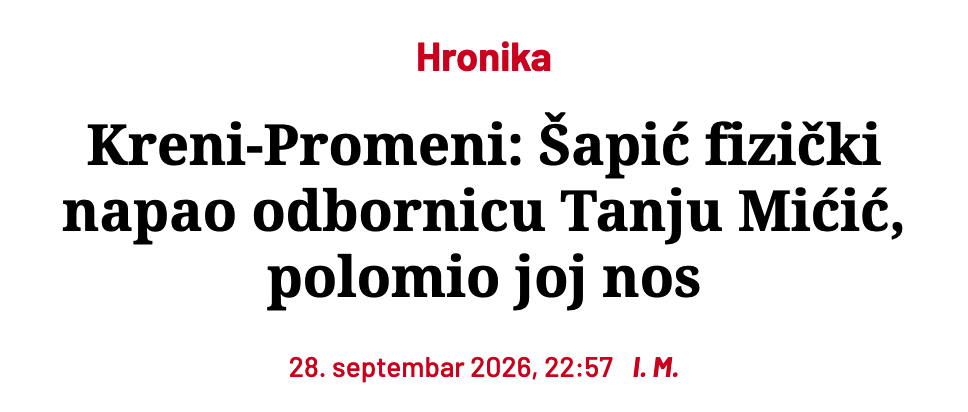
Phase II: 28 September, 23:00–00:30Šapić’s denial, a citizen gathering, and the tabloids weigh in
ShowHide 8 events
Šapić’s denial, a citizen gathering, and the tabloids weigh in
ShowHide 8 events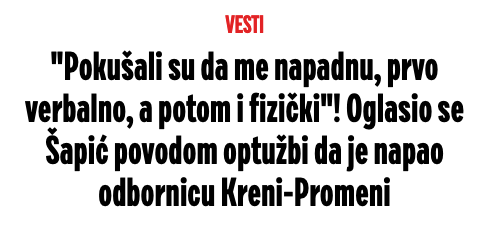
Phase III: 29 September, 01:00–09:00Conflicting claims about his detention
ShowHide 3 events
Conflicting claims about his detention
ShowHide 3 events
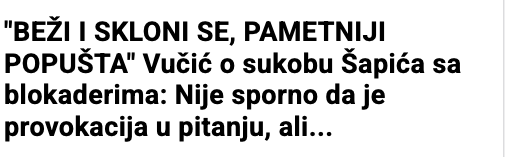
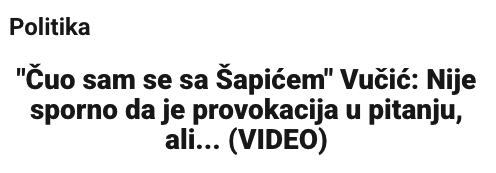
Phase IV: 29 September, 09:23–11:00Vučić and the prosecution step in, coverage turns
ShowHide 6 events
Vučić and the prosecution step in, coverage turns
ShowHide 6 events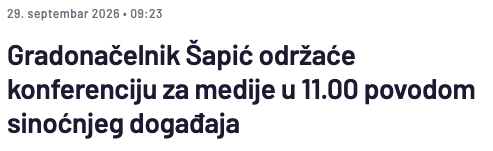
Phase V: 29 September, 11:00–15:00Šapić’s press conference and a second video surfaces
ShowHide 6 events
Šapić’s press conference and a second video surfaces
ShowHide 6 events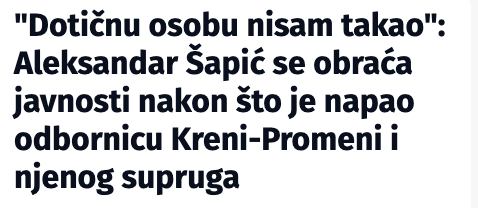
Phase VI: 29 September, 13:59–24:00Vučić’s tone shifts, a support rally
ShowHide 6 events
Vučić’s tone shifts, a support rally
ShowHide 6 events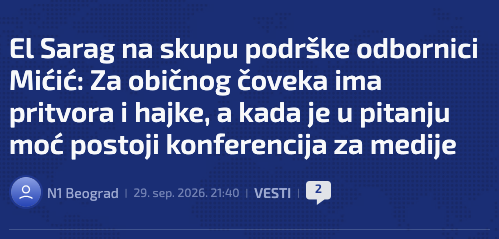
The highest volume of coverage came the following morning, 29 September, between 10:00 and 11:00, when 39 articles were published. Within about an hour, Vučić’s statement and the prosecutor’s office statement reached a wider audience through newsrooms. This was also the only hour when “incident” displaced “attack” in headlines, while “provocation” and “clash” appeared in headlines for the first time.
During the day, Šapić denied hitting Mićić, announced lawsuits and rejected calls to resign. Kreni-Promeni then posted an image of the medical report on social media, while opposition parties, civil society groups and feminist organisations called for Šapić to be removed from office. Nova, Insajder and Danas covered an evening gathering in support of Mićić; no pro-government site did.
Volume was not a question of capacity
Nova published 26 articles, N1 24, Danas 21 and 021 12; Informer and Insajder published ten each. Novosti, Telegraf, Politika and Pink published two or three. The lack of early coverage cannot be explained by newsroom inactivity: that evening, between 18:53 and 22:37, Novosti published 11 other articles, but did not publish its first article about the case until 09:43 the next morning.
How many articles each outlet published
Number of articles about the case, by outlet.
The main difference between independent and pro-government sites was not the timing of their first article – the gap was about an hour – but what they published. Kurir, for example, first published Šapić’s denial at 23:28, but did not name the injury until 14:57 the following day.
Readers also received the basic information in a different order. On Kurir, 15 and a half hours passed between the first article repeating Šapić’s denial and the first one naming the injury. RTS showed a similar pattern, with a 14-hour gap, as did 021, with a gap of nine and a half hours. Nova, N1, Danas and Vreme did the reverse: they first reported the allegations of an attack and injuries, and only nine to ten hours later published Šapić’s version of events.
How the incident was described
The words used shape how responsibility for an incident is understood. “Attack” implies a perpetrator; “incident” removes one; “clash” presents two sides as equal; “violence” places the event in a broader category. None of the terms Šapić used – “scuffle” and “set-up” – appeared in a headline. Nor did “beating”.
What the outlets called the event
Has a perpetrator
- Nova
- Insajder
- N1
- Danas
Category of act
- Nova
- N1
- Insajder
Two sides, treated equally
- RTS
- B92
- Novosti
- Mondo
No perpetrator
- Kurir
- Pink
- Srbija danas
- Politika
- Informer
Nova, N1 and Insajder use both the word ‘attack’ and the word ‘violence’.
“Attack” was the most common term, appearing in 57 headlines. In 16 cases, however, Šapić was presented as the person attacked. “Incident” was the standard wording on Kurir and Pink, while “clash” appeared in eight headlines, exclusively on B92, RTS, Novosti, Mondo and Srbija danas. “Violence” appeared in only five headlines, all on Nova, N1 and Insajder.
The shift in wording has a clear point in time. “Provocation” did not appear in headlines before 09:00 on 29 September, nor did “clash”. Both peaked at 10:00, when “incident” appeared in 15 headlines and displaced “attack” for the first time. That was when Vučić said there was no doubt that it was a provocation; Informer used the word in three headlines and Novosti in one. The wording changed alongside the shift in which sources were setting the pace of the story.
Who gets to speak
Šapić was a subject in almost every article that mentioned him. Alo and Republika quoted him in every such article; Nova in half, and N1 in a third. By contrast, Tatjana Mićić was not quoted at all by Informer, Kurir, Republika, Alo, B92, Srbija danas, Novosti, Pink or Telegraf. N1 quoted her in 13 articles, Nova in ten and Danas in eight.
This imbalance matters especially in light of the account that Mićić was pushed aside while Šapić defended himself from her husband. Although physically injured, the woman becomes a secondary figure in this version of the main event: a clash between two men. Unlike Šapić, the other man was not given a chance to speak in the media. In about half of the articles analysed, there are two people quoted – Šapić and Mićić. In the other half, only Šapić speaks in his own words, while Mićić is mentioned and spoken about.
Savo Manojlović was quoted in almost every article in which he appeared, but only on independent sites; pro-government sites did not carry his statements. The distribution of sources therefore reflects more than a difference in tone: it also shows who is allowed to define the facts and political meaning of the incident. Šapić’s voice appears across all the sites, while Mićić, her husband and representatives of the movement are heard selectively.
Edits and shifts in framing
On the day after the incident, 29 September, newsrooms changed one in every three articles monitored and one in every six headlines. In the comparison week before the incident, headlines were changed in one in every 50 articles. Most edits enabled independent and opposition media to distance themselves from their initial coverage, add the prosecutor’s position or Šapić’s denial, and soften their wording. It did not become standard practice to tell readers when and why the original article had been changed.
For example, Vreme removed the claim about a fractured jaw and the request for Šapić to be detained from a later version. It recast the claim about the injuries as an attributed statement and added the prosecutor’s position and Šapić’s denial. Danas kept its description of the injuries, but the current version no longer names the person who caused them. By contrast, pro-government sites that reported the incident much later already had a ready-made defence of Šapić, so they had no reason to make subsequent corrections.
Nova changed its first report by turning a claim from Kreni-Promeni’s statement from attributed speech into the newsroom’s own voice, while N1 replaced attribution with a direct quote from the injured woman. The site Direktno removed Šapić’s claim at a press conference that he had pushed the woman rather than hit her, and added that the prosecutor’s office had been unable to contact the injured people overnight. The edits did not all move in the same direction, but they show newsrooms adapting to new institutional and political information.
In the first hours after the incident, Vučić was mentioned in a political context, mainly in opposition reactions linking the incident to a climate of impunity for those in power. The next morning, Vučić entered the narrative as an active participant: his statement, made between 10:00 and 11:00 on 29 September, appeared on 14 sites within 70 minutes – the most synchronised moment in the dataset. Independent sites highlighted his remarks in their headlines that there was no excuse for Šapić’s actions, that he alone was responsible and that he should have stepped aside. Pro-government sites stressed that it was a provocation and that “the wiser person backs down”.
In the afternoon, the tone shifted further. Vučić said that everything Šapić had said at his press conference was “true” and stressed that he should not have allowed himself to be provoked. The gap between the morning’s condemnation and the afternoon’s endorsement passed without any visible media examination of this change in position. At the same time, the word “blockaders” appeared in headlines on Novosti, B92 and Informer.
By the end of the day, N1 and Vreme were also presenting the case as a question of political damage to the governing party during the election campaign, moving the focus further away from the injured woman and the course of the proceedings.
Gender and political framing
Four narrative frames stand out in the dataset: gender-based violence, put forward by Kreni-Promeni, students and feminist organisations; political violence and impunity for officials, put forward by the opposition; provocation and political intent, put forward by Šapić and Vučić; and a procedural frame used by some pro-government sites to explain why Šapić was not detained.
The gender dimension is visible in the language used, who was quoted and what information was left out. No pro-government site described the incident as violence. Eight sites did not name Mićić’s injuries. One of them, Informer, published the medical report as a photograph and presented it as evidence, but did not say what it contained in the article. Šapić’s defence, followed by Vučić’s statements, shifted the focus from whether the woman had been injured to the alleged clash with her husband, as well as speculation about Šapić’s character.
Algorithmic distribution
Because the social media sessions had ended before the incident took place, none of the simulated personas saw a post that night. The first posts appeared on 29 September between 09:21 and 11:29. This is a limitation of the data collection, not a finding about algorithms.
The pro-government persona was the first to see Šapić’s version, on X at 09:21, in a post saying that he had been attacked verbally and physically. At 09:33, a pro-student persona saw a post saying the mayor had hit a councillor; another persona received the medical report at 09:45. TikTok delivered only four of the 285 posts describing the incident. This result should be treated with caution because the search was based on caption text, while the message on TikTok was in the video itself.
Only one in four posts delivered to the personas described what had happened; three quarters were reactions, calls for Šapić to resign, messages about the prosecutor’s office or reports of Vučić’s statements. Pro-government personas encountered the case almost exclusively through reactions and counter-narratives. Their sources differed sharply: pro-student personas mainly saw Savo Manojlović, Danas, N1 and Insajder, while pro-government personas mainly saw Tanjug, Informer and nistv.rs. The only account seen by all ten personas was Kreni-Promeni’s.
One pro-student persona on X saw 23 posts describing the incident and 100 reactions; a pro-government persona saw two posts about the incident and 37 reactions. On Instagram, the ratio for one persona was 31 to 46, and for another 15 to 13. Although the balance differed across platforms, the common pattern was that the basic news story quickly disappeared from the feed and the case became material for political messages that were already in circulation.
This finding should be read alongside the limits of the sample: a persona does not represent an average user, and the sessions do not capture all activity on the platforms. Even so, differences in the sources shown and the order of the first posts indicate that people did not encounter the case in the same way. One persona first saw Šapić’s denial, another first saw an account of the attack, and a third received the medical report. Kreni-Promeni’s content was a rare point of overlap.
Key findings
- The shift in coverage came from selective use of the same Vučić statement, not just from subsequent changes to articles.
- Independent media first reported the allegations of an attack and injuries, then softened their coverage through edits; pro-government sites entered the story later, with a defence of Šapić already in place.
- “Attack”, “incident” and “clash” were not stylistic variations but different ways of assigning responsibility.
- Nine sites did not quote Tatjana Mićić, eight did not name her injuries, and her husband was not quoted at all.
- On social media, the case quickly shifted from a news story to a prompt for political reactions, with sharply divided sources and information.
Note on the use of AI tools: This report was put together with the help of an AI chatbot for data processing and copy-editing. The authors and editors take full responsibility for the research, analysis, findings and conclusions of the report.
Related content
IZBORI 26: Državnik, zaštitnik i ćacike
Foto: Reuters Nedelja #02 Proteklu nedelju obeležila je Vučićeva ostavka i put do nje, na kome je nastupao kao državnik prema svetu i kao zaštitnik prema biračima kod kuće. Glavna nova linija vlasti bila je kampanja o zaštiti žena, izgrađena oko spota studenata Fakulteta dramskih umetnosti. Treća nedelja monitoringa izborne kampanje obuhvata period od 21. […]
28. September, 2026.

IZBORI 2026: između online medija i fida
Raspisivanjem vanrednih parlamentarnih izbora u Srbiji započela je izborna kampanja koja će se u značajnoj meri odvijati u digitalnom prostoru. Onlajn mediji i društvene mreže važno su mesto političke komunikacije i informisanja građana, ali i potencijalnih pritisaka i povreda digitalnih prava. Zbog toga tokom kampanje pratimo kako se o izborima izveštava u onlajn medijima, kako […]
14. September, 2026.
IZBORI 26: Kampanja bez sagovornika
Nedelja #01 Vlast je kroz sve velike medijske kuće plasirala niz usklađenih poruka, ponekad u istoj formulaciji u više medija istog dana. Opozicija je imala svega nekoliko, pretežno reaktivnih. Druga nedelja monitoringa izborne kampanje obuhvata period od 14. do 20. septembra. Sa 25 posmatranih portala onlajn medija prikupljen je 28.371 tekst. Na društvenim mrežama analizirano […]
21. September, 2026.