News
A campaign that runs itself
On Monday 14 September, a column of people set off from the Rectorate of the University of Belgrade towards the headquarters of the Republic Electoral Commission (REC). At its head was a replica of the Victor monument, carrying a box in his left hand instead of a falcon. Candidates and students followed, also carrying boxes filled with collected signatures. That evening, social media feeds were flooded with images of the scene, filmed from every possible angle. Veroljub, the “blockade hero”, came to see the list submitted. Someone filmed the REC building, shouting “Let’s go, all the way to victory!!!!”; someone else reported that the signatures had been handed in. For days, these accounts had been sharing reports of seemingly endless queues to sign for the Students’ List, footage from the River Begej in Zrenjanin, and a New Belgrade notary saying he would keep working, if necessary, “until he fainted”. Nobody coordinated these posts. People filmed what they saw and put it on social media.
Two days after the list was submitted, the movement’s main Instagram account, @studenti_u_blokadi, changed its name from “Self-organised Student Group, Blockade” to “3. Students’ List, Students Are Winning”. The message was familiar. A banner reading “Students Are Winning!” had appeared at the Rectorate on 31 March; in April, at the students’ invitation, the slogan appeared on lampposts and in lifts across Serbia. The list did not need to invent language the movement had already been using for months.
The Students’ List’s election campaign brought something new to Serbia’s political culture. Instead of echoing messages choreographed and issued from headquarters, the campaign is carried by a network that nobody coordinates, not even the movement itself: local assemblies, faculties under blockade, local student accounts and citizens making their own content, in their own words and at their own pace. The students added two things this network does not produce on its own. The first is a set of visual templates that local assemblies and communities adapt for their area. The second is paid advertising, launched on 3 October, which made the list Meta’s largest single advertiser in this election campaign. These two channels carry the message: “We know how”.
Decentralisation, spontaneity, depersonalisation, trust and directness have shaped a different kind of political campaign. It has no single command centre and is not tightly organised from the top down. This is not the campaign of an individual or a party, but of a collective “we”, built on credibility and trust. Communication does not depend on media intermediaries: messages travel directly, from an X post to a sticker in a lift.
As trust in institutions declined over many years, people came to trust one another. They first came together through solidarity, and then became the campaign’s main carriers. Their participation, independent initiatives and sense of belonging allowed the campaign to spread organically and created a distinctive model of political mobilisation.
This model gives the electoral list something money cannot buy: credibility and reach. But it takes away what is usually bought in politics: control over the message, image and framing.
This is the SHARE Foundation’s final case study in its monitoring of the campaign for the parliamentary elections on 25 October 2026. It covers the period from 10 September to 17 October and draws on the feeds of ten simulated users on TikTok, Instagram and X, grouped into four clusters based on focus groups; 25 online news outlets; Meta’s Ad Library; and focus groups. Presence in a feed is not the same as reach across the population, and reported ad spend is the upper end of the range provided by Meta.
A timeline of the uprising
From the station canopy collapse to the election
Key milestones in the movement and the campaign
- 1 Nov 2024Novi Sad railway station canopy collapses; 16 people killed
- 22 Nov 2024“Stop, Serbia!” action and attack on students outside the Faculty of Dramatic Arts
- 25 Nov 2024Faculty of Dramatic Arts goes under blockade
- 12 Dec 2024First student gathering outside RTS
- 22 Dec 2024Rally in Belgrade (Slavija Square)
- 31 Dec 202415 minutes of silence in Students’ Square
- 27 Jan 202524-hour blockade of Autokomanda junction
- 1 Feb 2025“1, 2, across 3 bridges” rally, Novi Sad
- 15 Feb 2025“Meet on Statehood Day” rally, Kragujevac
- 1 Mar 2025Rally in Niš; Student Edict proclaimed
- 15 Mar 2025“15 for 15” rally, Belgrade
- 14 Apr 2025RTS blockade begins
- 5 May 2025Demand for early elections; list first announced
- 8 Jun 2025Local elections in Kosjerić and Zaječar
- 28 Jun 2025“See you on Vidovdan” rally, Belgrade
- 1 Nov 2025Rally in Novi Sad on the anniversary of the station canopy collapse
- 28 Dec 2025“Call elections, let’s win”: around 500 stalls; contact details collected with signatures
- 31 Mar 2026“Students Are Winning!” banner at the Rectorate
- Apr 2026Slogan emailed to people who signed
- 23 May 2026“You and me, Slavija” rally, Belgrade
- 9 Sep 2026Election called; citizens’ group formed
- 14 Sep 2026Electoral list submitted to the REC
- 3 Oct 2026List’s first paid adverts
- 22 Oct 2026Final rally, “Victory calls, Slavija”, Belgrade
- 25 Oct 2026Election
The student movement was born among the rubble of the Novi Sad railway station canopy on 1 November 2024, at 11.52 am. From the first day, the key word in public life was “accountability”: first for the collapse and the deaths of 16 people, then for the violence against those demanding accountability. The red hand and the message “Your hands are bloody” became symbols of that demand. The first action with a specific name, “Stop, Serbia!”, took place across the country on 22 November, when people observed 15 minutes of silence in memory of those who had died.
That day, while the action was under way, a group of men attacked students and professors outside Belgrade’s Faculty of Dramatic Arts as they paid their respects to the victims. In response to the attackers’ impunity, students blockaded the faculty on 25 November 2024. Within a month, many higher education institutions across Serbia were under blockade. The students set out four demands and introduced one of the pillars of their system, which would prove crucial to their later political engagement: plenums. A plenum has no formal leader or hierarchy. Everyone has the right to speak and the same amount of time to put forward a proposal, and each faculty under blockade makes its own decisions, without instructions from above.
As more faculties and secondary schools across Serbia went under blockade, it became clear that people wanted to mobilise, not only students but the wider public too. The blockades came to be seen as an act of heroic defiance and rebellion against violence, injustice, corruption and arrogance. Citizens felt they had to support young people in every way they could: people they had long thought were asleep, uninterested in politics and only looking for a way out.
It soon became clear that students were giving rise to a new kind of political practice. From the start, they used social media as their main means of communication because it let them send their message as they wanted: without a single centralised voice, and in full. Students’ faces were not in the foreground; the stewards’ vests worn at student rallies and actions took their place. Messages were never written in the first person singular, but always in the plural.
If anyone doubted the power of this mobilisation, that doubt was dispelled just a month after the blockades began. Some of the movement’s most recognisable images, which would later define the campaign too, emerged at Slavija Square on 22 December 2024. The rally was also the largest mobilisation to date, with estimates of more than 100,000 people in attendance.
Protests continued every day for weeks; support grew and the message spread. A system took shape in which a call for a protest or action on social media was enough to bring people together in the street within hours, sometimes minutes. In these groups, people found comfort, solidarity and a sense of belonging.
On the final day of 2024, a column made its way from Pionirski Park to Students’ Square and observed 15 minutes of silence at 11.52 pm, with the message: “There will be no New Year; you still owe us for the old one.” Silence became a ritual. To this day, the same accounts that carry the campaign continue to share the ritual as “16 minutes of silence”. In our data, it forms one of the largest visual groups, without any electoral-list branding.
This system of self-organisation and self-governance was one of the first messages the movement sent through its own channels. It closed 2024 and opened a new chapter in the student rebellion and struggle.
The second ritual was walking. In late January 2025, a group of students walked from Belgrade to Novi Sad for the “1 February, across 3 bridges” protest. Marches to major protests in other cities followed. Marches also bring the election campaign to a close: columns from across Serbia are meeting in Belgrade on the eve of the final rally at Slavija. Along the way, students spoke to people in places they could not reach through social media. Flags, the national anthem, religious symbols and the kolo – motifs the authorities had long treated as their exclusive domain – helped them attract attention beyond the big cities. Whether deliberately or not, the walks became a door-to-door campaign before there was any campaign at all.
The “A student in every village” initiative grew out of this experience and was announced on 6 March. The idea came from the Faculty of Electrical Engineering in Belgrade, in recognition of the need to speak directly to people in remote places where political life rarely reaches beyond propaganda in centrally produced broadcasts. By May 2026, the initiative had made more than 500 visits. One student from Kruševac reported villagers saying that “no party has set up a stall in our village in the past 20 years”.
Nine days later, on 15 March 2025, Slavija Square and the surrounding streets filled with an estimated 275,000 to 325,000 people, according to the Public Assembly Archive, making this probably the largest rally in Serbia’s history. During the 15 minutes of silence, a sound unsettled some of those gathered. Many Serbian and international experts attributed it to a sound cannon, which the authorities have never acknowledged using. The movement did not weaken; on the contrary. In the following weeks, citizens’ assemblies sprang up in neighbourhoods and municipalities across the country (at least 148 had been held by 30 March, according to Civic Initiatives). Individuals and groups, from cyclists to the diaspora, organised almost daily actions in support, without a central plan. The campaign would return to Slavija on 22 October 2026, as the final stop of the “Victory calls, Slavija” march.
In May 2025, the movement entered politics openly for the first time: it called for early elections and announced plans to field its own electoral list. Until then, it had insisted that its demands were moral, not political, aware of how discredited the word “politics” had become in Serbia. The first test came on 8 June, in local elections in Kosjerić and Zaječar, where the movement backed local opposition lists. The ruling coalition won in both places, amid violence and irregularities documented by election observers from Crta.
The campaign’s infrastructure reached a turning point on 28 December 2025. Under the slogan “Call elections, let’s win”, the movement collected signatures at around 500 stalls in more than 100 municipalities, in support of its demand for early elections. People signed two forms: one supporting the demand and providing contact details, and a “slightly more direct survey” about taking part in the campaign. The movement announced the following day that nearly 400,000 people had backed the demand. Around the same time, Vučić said there would be elections “soon, next year”. The movement called this action the formal start of its campaign. No party in Serbia had entered a campaign with such a contact list, and the email bulletin created at the time would become one of its main channels of communication in the months ahead.
When the then president called the election on 9 September 2026, the citizens’ group “Students’ List, Students Are Winning” was formed that same day, with 14 signatories, mostly university professors. The list of 250 candidates had been ready for months, but was published only after the election was called, for “technical and tactical” reasons. By the time the campaign officially began, the list already had its ground operation in place: local accounts in dozens of towns, a network that had visited villages, a contact list, an email bulletin and a Telegram channel. It did not need to build a campaign. It only had to steer it.
Pogledaj na TikToku
Throughout this period, the movement faced pressure that was not visible in the streets. In 2025, SHARE recorded more than 200 digital rights violations, up on the previous year, with the number continuing to rise in 2026. The most serious cases involved the use of advanced spyware against members of the movement and civil society activists. In a resolution of 22 October 2025, the European Parliament condemned the use of Pegasus and NoviSpy spyware, as well as Cellebrite forensic tools, against citizens. Since the start of 2026, the devices of at least 14 people have been targeted with advanced spyware. Activists also faced daily pressure on the ground. In the village of Jabuka in October 2025, a man smashed and threw away items from a student stall. In Darosava in February 2026, groups of people followed students, filmed them and kept asking, “Who’s paying you?” The campaign brought no respite: on 3 October, during a door-to-door action in Grocka, a man who said he had “worked at the University for 30 years” attacked a student with a grass trimmer.
The (un)personal PR of the Students’ List
According to SHARE Foundation’s analysis, the Students’ List is not running its campaign through its own network of accounts. Nor are the candidates’ personal accounts the channels through which the campaign is conducted. They and their activities are represented by a broad network of student-movement supporters, established well before the election was called.
By comparison, the lead candidate on the “Aleksandar Vučić – United Serbia” list is running his campaign personally through two Instagram accounts alone, and also has the ruling party’s channels at his disposal.
The Students’ List appears in the feeds through 28 accounts: its “headquarters”, the @studenti_u_blokadi account, which has 949,000 followers on Instagram, and the accounts of candidates on the electoral list that SHARE has confirmed are personal. Three quarters of the candidates have very little visibility on social media. It is particularly striking that the list has no account of its own on TikTok, the platform where focus group participants found student content most persuasive.
Three layers of the campaign
Who produces what, and when
Students’ List
28 accounts in feeds; none on TikTok
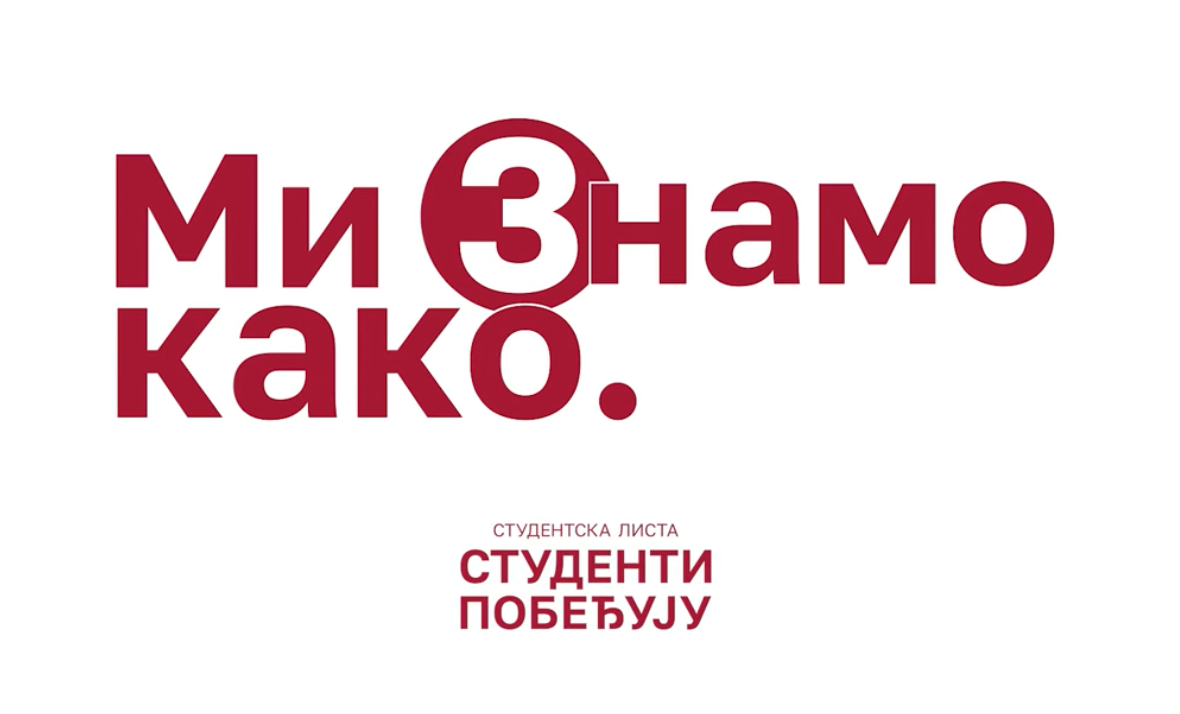
campaign voice:“We know how”
Paid layer
List’s Meta adverts; the campaign’s largest single advertiser
One message accounts for 71% of impressions; the rest mobilises people
Franchise layer
Central templates adapted and posted by local groups
Local accounts post them first; use falls in October
The only layer that reaches undecided voters
Organic layer
Assemblies, faculties, local groups and citizens create their own content
The movement’s voice: support, pressure from the authorities, candidates, corruption
So how are candidates presented? Through collective student accounts, such as the account of the Faculty of Medicine under blockade.
Local student groups, such as Students of Čukarica and Students of Požega, play a key role. Their accounts carry information about candidates, stalls, signature-gathering and campaign events, while the people behind them present themselves as part of the student movement.
The election campaign, then, is being run by a student-movement network that nobody coordinates. The list is just one part of that network.
The messages people send, and the images they receive
When people write for themselves, they most often write about how many people have turned out. “Thank you to everyone who supported the Students’ List with their signature this weekend, despite the long queues,” says the Faculty of Political Sciences under blockade. “The Guardians of the Constitution arrived in Niš this evening. Residents welcomed the student cycling group near the Niš fortress with music, flares and support,” posts a Niš resident. Then they write about pressure: “Our students in Trebinje! The police would not let them set up a stall, but that did not stop them carrying out the action without one.” Then about candidates, then corruption. Many posts have no message beyond a call to turn up, sign the list and vote.
What they do not write about is the language the list uses in its adverts. Plans, institutions, the team’s expertise and “We know how” appear in fewer than 2% of organic posts, and in just 4% of posts on the list’s own accounts. That language is present in the organic layer, but as an image.
There is no central hub in the way content spreads either. We applied the same coordination test to student content as to pro-government networks. Across assemblies, faculties, local groups, influencers and citizens, almost identical wording appears in 9–18% of posts; posts published in the same hour account for 1–2.5%; and an average of 30 to 90 minutes passes between the first and last post on the same topic. The ten most visible citizen accounts account for less than 14% of views. There is no hub turning everyone else into repeaters.
Identical wording appears more often among parties, organisations and individuals who support the students: in a third of posts, with 6.7% posted in the same hour. Their content spreads in eight minutes. This appears to be sharing, not coordination. They pick up content from student channels and share it with their own followers, so identical wording across accounts points to a common source.
People write for themselves. But the images are supplied.
How templates spread
Each dot represents one post using the same central template (“Student Plan”, a visual group shared by 38 accounts), arranged by posting time. Hover over a dot to see the account and exact time, or over the legend to highlight a group.
- Initiatives
- Citizens
- Local groups
- Assemblies and faculties under blockade
Channel handover
Local groups in the list’s templates and the list’s Meta spending, by campaign week. Hover over a week for the exact figures.
- local groups in the list’s templates (memberships in visual groups, left axis)
- list’s Meta spending, thousands of EUR, upper bound (right axis)
* Week 6 is partial (15–17 Oct), hence the hatching. Source: Meta Ad Library and simulated-user feeds.
Unlike text, images do have a centre. Seven of the 16 largest visual groups share the same design: a red frame, the “Students’ List, Students Are Winning” logo and Cyrillic text, with only the place and date changing. Accounts sharing the same visuals account for 77% of views of local groups and half of the movement’s views.
This is a kind of franchise. The list creates a visual package centrally, then local groups, assemblies and initiatives adapt and publish it for their area. The templates follow the campaign step by step. First comes “Čačak signs for victory”, with dozens of local versions on 12 and 13 September. Then “We know how! The Student Plan”, the “Guardians of the Constitution” cycling tour, the call for election monitors (“Be a hero, be an election monitor”) and, finally, “Victory is calling, Slavija 22.10.” Among local groups, central templates make up 71% of the visuals they share; among assemblies and faculties, 57%; and among citizens, around 10%. Citizens share photos from actions, their own designs and memes featuring the number 3.
However, the list is not the first to post the templates. Of the 84 template groups, the first account seen posting one is an assembly or faculty in 31 cases, a local group in 21, and the list’s account in only 15. Templates probably reach local accounts outside social media: on 17 September, 11 accounts posted the “Student Plan” between 6.00 and 6.04 pm. They spread faster than anything else, taking four and a half hours from the first post to the last, compared with 11 hours for original visuals.
The list cannot keep its brand under its control. When someone defaces a billboard reading “You deserve better. We know how”, an assembly in Vračar cleans it up and posts a “Before / After: we fixed it!!!” collage. The brand is defended from below. But it can also be appropriated from below: one visual group featured a fake poll with the list’s logo (“Students’ List 48.5%, SNS 38.5%”) that nobody officially published.
The franchise is at its most active in the first week of the campaign, when local groups appear in templates 58 times. By week five, that number has fallen to four. That is when the paid layer begins, on 3 October.
Turning it up to the max
Almost a month after the official start of the election campaign, the student movement only began promoting the Students’ List through paid Instagram and Facebook adverts on 3 October. And it did so in style.
By 17 October, the Students’ List had spent up to €180,656 for up to 37 million impressions – more than the three official SNS pages combined (“SNS”, “Aleksandar Vučić” and “Naprednjaci”, up to €150,284) over the entire period, and twice as much as they did in the second half of the campaign. This has not happened since Meta’s Ad Library became available in Serbia.
Two models of paid advertising
One list page compared with SNS’s spending spread across several pages. Each segment represents one page. Hover over a segment to see the page name and amount.
Meta ad spend, 10 September to 17 October 2026, thousands of euros (sum of upper estimates)
Source: Meta Ad Library, as of 18 October 2026. Amounts are the upper limits of the ranges published by Meta.
But there is always a “but”: the official SNS pages do not show the full picture.
The ruling party is also served by 21 pages that do not carry the current regime’s stamp, from “Nacionalni Magazin” and “Politički Puls” to “Za Evropu” and “Srbija Brale”. In an internal analysis of coordinated behaviour, SHARE Foundation identified them as satellites of the ruling party that share its messages. Including these pages, SNS spent up to €278,930 over the whole period and generated up to 121 million impressions, three times more than the Students’ List. The student option also pays more per impression.
The analysis also reveals how the two electoral lists use their advertising spend.
Through paid political adverts, the Students’ List promotes its programme and mobilises citizens without directly attacking its opponents, and directs most of its content at women (69%). Official SNS accounts promote Vučić, while around 4% of SNS adverts attack students. The attacks are left to “unofficial” pages, which also run even harsher attacks on the student movement and the Students’ List. SNS and its wider network mainly target men and people over 55.
The Students’ List adverts do not introduce new messages. Each of the five messages used in its adverts had already appeared organically before 3 October. Money was used to select and amplify what was already circulating, and to reach audiences the organic layer was less likely to reach.
The two models are mirror images of the organic layer. In paid advertising, SNS looks decentralised, with a highly coordinated presence spread across dozens of pages. The Students’ List is centralised in paid advertising, with one page and one voice, but it amplifies what is created from below.
Who are the students reaching?
For an undecided 24-year-old woman who had never voted and followed only lifestyle influencers on social media, the algorithm put almost as much student content in her feed as it did for people who knowingly follow the students: 6.7% compared with 8.8%. In other words, the students are reaching people who do not follow politics.
Among people who might be inclined to support the students, the picture is mixed. For an industrial worker in a smaller town who trusts nobody, student content rises from 1.6% of the feed in week one to 4.2% in week six. For a right-wing man who accepts the students only when they are framed in national terms, it rises from 2% to 3%. By contrast, student content becomes less visible to a middle-aged businesswoman and a young freelancer.
Who carries the list
Share of student content in the feeds of simulated social media user groups, and how much of it is carried by citizens and by the list. Hover over a group to see the proportions.
- All student content
- Of which: citizens
- Of which: list
Source: Simulated users’ feeds, 10 September–17 October 2026; clusters based on focus groups. Share of feed views, not population reach.
The study shows that some people are gradually moving closer to the students, but not everyone.
Hardline SNS voters – the party’s core supporters – remain in their own bubble. For a pensioner in eastern Serbia and a young party activist, pro-government content makes up 31% of the feed, while student circles account for 1.2%, with no change during the campaign. Student content keeps appearing, but in amounts that, according to the focus groups, people do not notice.
How online outlets write about the Students’ List
Pro-regime media mostly avoid calling the Students’ List and its candidates by their names, instead using “blockaders” and “blockader list”.
The analysis found that “blockaders” appeared in headlines 4,583 times, compared with 3,181 mentions of the “Students’ List”. B92, Pink and Kurir mention the list most often; it features in around 15% of their political articles.
As expected, the tone towards the list and its candidates is negative. Informer, Republika and Pink treat the Students’ List as exclusively negative, while Nova, 021 and N1 treat it positively.
The cost of decentralisation
In the information space, decentralisation gives the Students’ List what money cannot buy: credibility and reach. There is no account whose removal would stop the spread. There are no repeated formulations reducing the campaign to the usual echo among supporters, which sets the list apart from every other actor we monitored. The movement had already built the ground operation, so the list did not have to. It reaches people electoral lists cannot reach on their own: a young woman voting for the first time who has yet to make up her mind, a worker who no longer trusts anyone, a right-wing voter with ideological reservations about the students – and it reaches them through citizens taking part in the campaign organically.
This is a risk political actors in Serbia have not taken before, because it puts control over the message and its context in question. The list itself is almost invisible. It has no TikTok account, and simulated users saw no account for 207 of the 250 candidates. Candidates appear through collective accounts and are hard to distinguish from the movement, while online outlets call the list “blockader” more often than they use its name.
The Students’ List campaign began with a column heading towards the REC, whose visibility nobody coordinated, yet it flooded social media feeds. The campaign will end with a rally at Slavija on 22 October, promoted through templates for local groups in remote parts of Serbia and through paid social media adverts. What people film and share there will not be scripted in advance. It will be a collective decision.
Note on the use of AI tools: This report was prepared with the assistance of an AI chatbot for data processing and language editing. The authors and editors retain full responsibility for the research, analysis, findings and conclusions in the report.
Related content
IZBORI 26: Glas u ponoć
Foto: Frankfurt uz studente Nedelja #04 U poslednjim nedeljama pred izbore glavna tema postala su pravila samog glasanja: ko glasa, kada i sa kog spiska. Vlast poručuje da je izborni proces uredan, a priče o dijaspori, biračkom spisku i spisku „blokadera“ iz Čačka nose gotovo isključivo nezavisni mediji. Četvrta nedelja monitoringa izborne kampanje obuhvata period […]
12. October, 2026.
Nalozi bez lica, vesti bez provere: kako onlajn mediji dele dezinformacije (i izvore)
Nalog @Silvana71376830 na mreži X nema ime, lice ni istoriju objava. Ipak, kada nešto objavi, portal Pink to po pravilu pretvori u vest za svega dva i po minuta. U 16 slučajeva Pink je objavio članak u kom se „citira“ tvit sa ovog naloga čak i pre nego što se tvit uopšte pojavio. To je […]
14. October, 2026.
IZBORI 26: Povratak u Novi Sad
Foto: 021.rs Nedelja #05 Sedmicu uoči izbora obeležila je ispovest dugogodišnjeg aktiviste SNS-a o plaćenim batinašima i oružju u Ćacilendu. Priču su nosili nezavisni mediji i društvene mreže, provladini mediji je nisu ni pomenuli. Nezavisni mediji gotovo da nisu izveštavali o mitingu SNS-a u Novom Sadu. Peta nedelja monitoringa izborne kampanje obuhvata period od 12. […]
19. October, 2026.