
News
ELECTIONS 26: A Vote at Midnight
Photo: Frankfurt uz studente
Week #04
In the final weeks before the election, the rules of voting itself have become the main subject: who votes, when, and from which voter register. The authorities say that the electoral process is in order, while stories about the diaspora, the voter register, and a list of “blockaders” from Čačak have been carried almost exclusively by independent media.
The fourth week of election-campaign monitoring covers the period from 5 to 11 October. We collected 30,831 articles from 25 monitored online media outlets. On social media, we analyzed 132,281 posts from TikTok, Instagram, and X that the platforms’ algorithms showed to ten simulated users. Based on the content they receive, we group these users each week into four feed clusters: pro-government, pro-opposition, pro-student, and undecided.
The Week at a Glance
In online media, the week opened with the Republic Electoral Commission’s decision that voting abroad would take place according to local time in Serbia, meaning that voters in North America and Australia would cast their ballots in the middle of the night. The Student List filed an objection, followed by a protest outside the Republic Electoral Commission. In Niš, Vučić accused supporters of the Student List of attacking an SNS activist, the third case of violence against a woman in three weeks to become a central message of the authorities. At the same time, pro-government outlets carried several claims that were not supported by the original quotations and statements.
On social media, the electoral process was the main topic in all feed clusters except the pro-government one, and the call for a protest outside the Republic Electoral Commission was the only image of the week that reached three of the four clusters. In the pro-government feed of one simulated user, a fourth account from the same family of anonymous pro-government profiles took first place.
We recorded five cases involving digital rights and freedoms, including the publication of a list containing the personal data of citizens of Čačak and a warning that state-backed attackers were targeting the email accounts of a political party.
In online media, Vučić remained in first place, but with substantially fewer mentions than the previous week. The word student rose from 104th to 38th place, and media from 62nd to 43rd, reflecting the increase in articles targeting media outlets and journalists.
On social media, the electoral process suddenly came to the foreground. The Republic Electoral Commission rose from 287th to 53rd place, diaspora from 266th to 58th, voting from 108th to 51st, and protest from 74th to 48th. Šapić, the 27th most frequent word last week, dropped out of the top 300.
Media Review
The Electoral Process as an Independent Media Story
On 5 October, the Republic Electoral Commission adopted a decision on polling stations abroad, following a proposal from the Ministry of Foreign Affairs. Polling stations will be open from 7 a.m. to 8 p.m. Serbian time, meaning that voting will take place at night in some parts of the world and that voters will have to travel farther because of the reduced number of stations. Foreign Minister Đurić called claims of obstruction lies. The Student List filed an objection, and a protest was held outside the Republic Electoral Commission on 7 October.
According to SHARE Foundation’s analysis, N1, Danas, Nova, 021, and Insajder carried this story, while pro-government outlets published only a few articles about it. The same pattern applied to the voter register. On 3 October, N1 reported that journalist Mladen Savatović had been attacked by Vladimir Mandić’s father while filming in Savski Venac, and also reported that 147 voters were registered at the same address in a building N1 linked to Vladimir Mandić. By the end of the week, Danas had identified the attacker, while Nova, 021, and Insajder followed the story. Vreme wrote about people listed in the voter register without residential addresses. Alo, Informer, Novosti, Kurir, and B92 mentioned Savatović only through Brnabić’s claim that he was lying and in an article about a “race to foreigners,” not in connection with either the attack or the building.
Only N1, Danas, and Nova reported on the list of “blockaders” containing the personal data of Čačak citizens, including ANEM’s warning and the citizens’ protest outside the local police department. No pro-government outlet published an article about it.
Meanwhile, the authorities maintained that the process was in order: the voter register had been finalized, the Republic Electoral Commission had determined the number of voters, and the chair of the REM Council highlighted ongoing proceedings and the fact that the media regulator was overwhelmed by complaints, most of them against Informer.
ODIHR’s interim observation report, published on 10 October, followed the same pattern of sharply divergent coverage. The report notes that the Republic Electoral Commission met all legal deadlines, but also that recommendations related to pressure on voters, the misuse of public resources, and journalists’ safety remain unimplemented, and that the authorities have not explained discrepancies in the voter register. Tanjug, Informer, Alo, Pink, B92, and Kurir highlighted the positive findings in their headlines, while N1, Danas, Nova, Insajder, Vreme, and 021 emphasized the critical ones. Informer presented the report as a largely positive assessment, while Danas focused on its notes of the political crisis and polarization. Politika published both versions, the positive one first and the critical one an hour and a half later.
Niš: A Third Consecutive Week With a Case of Violence Against a Woman
On the evening of 7 October, Vučić said that “blockaders” in Niš had attacked 26-year-old SNS activist Anđela Milosavljević. Kurir and Pink ran his statement that “[blockaders] have an incredible obsession with women” under the same headline. Student Mateja Nikolić was detained, while his lawyer said there were no grounds for detention. This is the third such case in three weeks, following the “I too am a ćacika” campaign and the incident near the Futoška market.
Niš was also the scene of other events. During an SNS gathering on 5 October, a fire broke out on the ramparts of Niš Fortress after flares were set off. A Zoomer correspondent was attacked and struck in the head while filming an SNS booth, which ANEM condemned. At a Student List gathering on 10 October, a group of young men carrying a flag bearing Ratko Mladić’s image moved through the crowd. Pro-government outlets wrote that “blockaders” had attacked the men with the flag, while Informer used an ethnic slur in its headline for a list representative who allegedly led the attack.
Unsupported Framing
According to SHARE Foundation’s analysis, pro-government outlets carried several claims this week that were not supported by the original statements.
Informer claimed in a headline that Olja Bećković had “revealed that the opposition is preparing forced Thompson concerts and rapes for us,” but the quotation from her show Utisak nedelje does not say this. The source was a post by the anonymous account @LaziDetektor, embedded in articles by Politika, B92, Informer, and Pink. Alo, Novosti, and B92 carried the same story under nearly identical headlines.
Six pro-government outlets presented Student List candidate Sanja Belić’s proposal to update the voter register as an intention to “strip pensioners and persons with disabilities of their right to vote.” Kurir, Alo, and Novosti published it under the same headline: “No End to the Blockaders’ Morbidity.” Her statement does not refer to taking away voting rights, and no neutral article about the proposal was published.
The number of articles targeting media outlets and journalists also increased, mainly in Novosti, Alo, and Informer. In addition to N1, journalists from Deutsche Welle, including Nemanja Rujević, became new targets.
Government Messages
- Sovereignty and an absolute majority. Vučić says that no one abroad gives him orders and that his list will win an absolute majority.
- Rallies as a show of strength. B92 reported announcements of a gathering in Novi Sad that would be bigger than the one at the Arena, as well as a call for a gathering in Kragujevac.
- Care for vulnerable people. Minister Đurđević Stamenkovski visits nursing homes and announces support, Politika and Tanjug reported.
- An orderly electoral process. Republika and B92 reported that the voter register had been finalized and the number of voters determined.
- Infrastructure. A railway to Budapest in early November, a program for southern Serbia, and the Belgrade-Zrenjanin highway.
- Higher wages and pensions from 1 December, the finance minister announced, according to Pink.
Opposition Messages
- Return of Belgrade’s former police chief. Student List candidate Mario Reljanović questioned the return of Veselin Milić, 021 reported.
- Security at the military airport. Petar Bošković described footage from Batajnica as a “national disgrace,” Nova reported.
- Šapić. PSG’s Stefan Simić said that the authorities’ silence about Belgrade mayor Šapić showed weakness, Danas reported.
- Support for a minority government. Ponoš did not rule out conditional support for a Student List minority government, Danas reported.
- Health care and confiscation of unlawfully acquired assets. European Serbia said that the authorities were lying about the state of health care and announced a fund to recover stolen money.
- A competent alternative. Đilas said that Serbia needs a clear vision and management experience, N1 reported.
Other Messages
- Pardons. Lawyer Jovan Rajić said that Vučić’s pardons were probably unlawful, N1 reported.
- Vulnerable citizens at the Arena rally. The Roma Party said that socially vulnerable citizens had been brought to the rally under pressure, N1 reported.
- Detention in Zrenjanin. The PUF movement said that police detained two of its activists during an SNS rally, N1 and Vreme reported.
What Was in the Feed
Diaspora and the Republic Electoral Commission in the Feeds
Voting abroad, objections, and the protest outside the Republic Electoral Commission appeared in the feeds of all ten simulated users, but least often in pro-government feeds. In the other feeds, media and activist accounts drove the topic, including news about voting hours (@Insajder_net, X, 5 October) and calls to submit objections jointly (@blok_radio, X, 6 October).
In pro-government feeds, the topic appeared through news posts, but also through anonymous political accounts mocking the protest turnout, such as the message that they “can no longer gather 10,000 people even in Belgrade” (@thepcelar, X, 7 October). There was also a claim that ODIHR had positively assessed the work of the Republic Electoral Commission in its interim report (@BakarecPolitika, X, 11 October), as well as an attack on CRTA as an organization that “openly works for blockaders” (@vaseljenska_rs, Instagram, 8 October).
Niš in the Feeds
In pro-government feeds, the alleged attack on Anđela Milosavljević appeared through the official SNS account and Informer (@InformerNovine, X, 8 October). The fire at Niš Fortress was presented there as fabricated, along with a claim that the photographs were “100% AI-generated” (@KetiKeti347710, X, 10 October).
Other feeds carried news that firefighters had confirmed that vegetation on the ramparts had burned (@n1srbija_, Instagram, 8 October) and that Mateja Nikolić had been released after more than 40 hours due to insufficient evidence (@masina.rs, Instagram, 10 October). Both feed ecosystems interpreted the flag bearing Ratko Mladić’s image as a provocation of the other side.
Who Was Speaking
In pro-government Instagram feeds, the account klipperdanijelizborne2 ranked first, ahead of Vučić’s official account @avucic. It is the fourth account from the same family of anonymous pro-government profiles. It appeared on the morning of 5 October, the day after the previous account, klipperdanijelsrbiizborne, made its last post. Instagram labels it as an AI profile and almost every post as artificially generated. More than half of the posts use the same slogan, “United Serbia wins” (@klipperdanijelizborne2, Instagram, 9 October). Each of the four accounts in this family was active for around ten days, and its successor appeared immediately. All four have appeared exclusively in the feed of one simulated user, an SNS supporter over the age of 65.
Visual Content
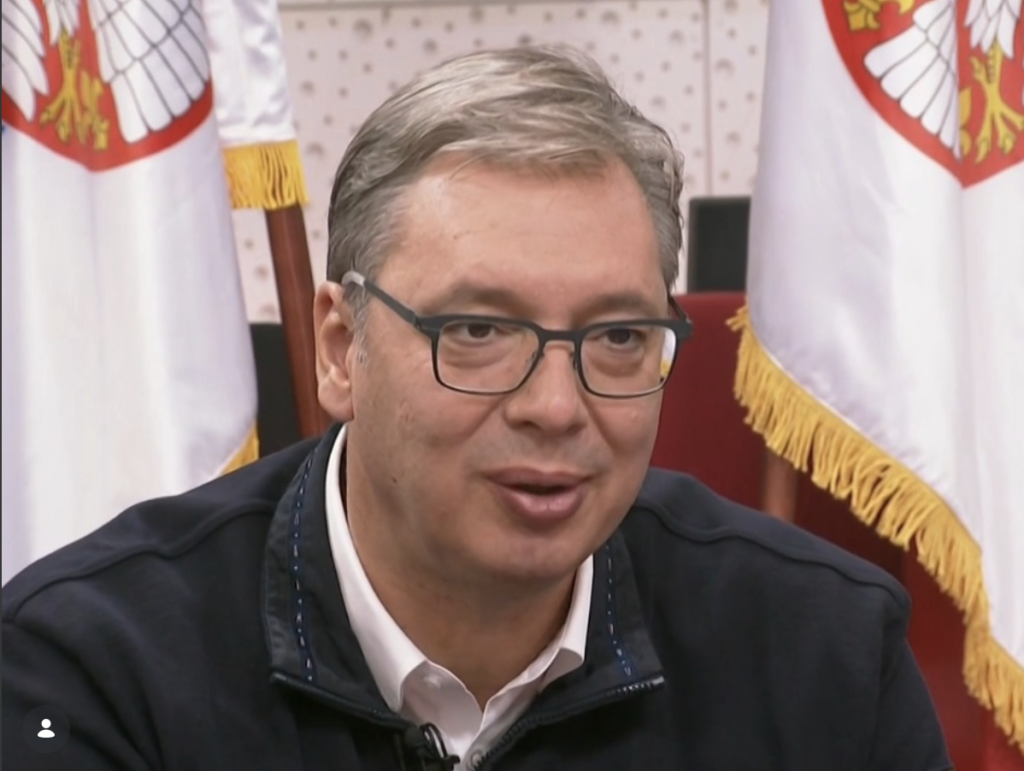
This week, two images recurred across the feeds.
In pro-government feeds, the most frequently repeated image was a photograph of Vučić alongside his claim about the attack in Niš (@sns_srbija, Instagram, 7 October). Five X accounts posted the same photograph between 9:33 p.m. and 11:53 p.m. that evening, each with different pro-government text, including @DarkoBogKV and @Dunja00117. Four of the five accounts had appeared in the feeds we monitor in earlier weeks, while the fifth appeared for the first time with that post.
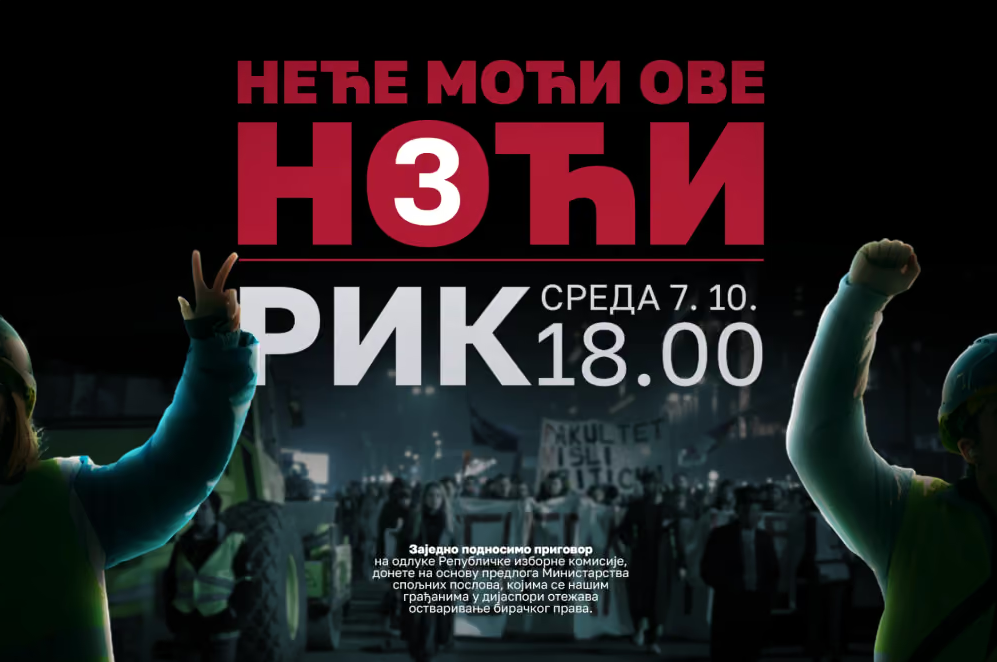
The students’ call for the “They Will Not Get Away With It Tonight” protest outside the Republic Electoral Commission on 7 October (@studenti_u_blokadi, Instagram, 6 October) was the only image of the week to reach pro-opposition, pro-student, and undecided feeds. It did not reach pro-government feeds.
Meta Ads
The Student List was the largest advertiser by total spending among ads active during the period, ahead of Aleksandar Vučić. Its most frequently displayed ads referred to a state in which the law is respected and called for campaign contributions. However, none of the Student List ads overlapped with any posts in the feeds we monitor.
Vučić’s ads carried the message “For a stronger, safer, and prouder Serbia,” while SNS ads announced new roads. The most frequently displayed ad by the Party of Freedom and Justice said, “Every dictator gets their 5 October.” Ads from the Nacionalni magazin and Naprednjaci pages were shown most often to women over 65.
The list “Dad, This Is for You,” number 15 on the ballot, had low-spending ads with a high number of impressions, including ads about cannabis legalization. Its posts appeared in the pro-government feed of one simulated user.
Rights and Freedoms in the Digital Environment
In Čačak, a list containing citizens’ personal data was widely shared, including alleged “capillary votes” (votes secured through institutional pressure, job blackmail, and systemic clientelism) and “blockaders.” Those labeled as “blockaders” are mostly students, teachers, new voters, opposition representatives, activists, and journalists, Ozon Press reported. Citizens named in the list and local media say that it was leaked from SNS, N1 reported. This is the second privacy-related case during the campaign, following calls by surveyors claiming to act on behalf of SNS, recorded on 21 September.
The independent outlet Kompas reported that, a few days after a bot attack, it had again become a target as posts from its Instagram account were removed following mass reporting of its content.
The Movement of Free Citizens received a warning from Google that state-backed attackers were attempting to compromise its email accounts, N1 reported.
ANEM warned of a third wave of threats in one month against Kristina Demeter Filipčev, deputy editor-in-chief of Bečejski mozaik. The threats, involving sexual insults, misogynistic attacks, and ethnic slurs, intensified after her reporting on the ruling party’s campaign activities. The first wave was recorded on 21 September.
Tabloids reported that a mass obstruction was being prepared for election day, in which children would lock their parents in the house to prevent them from voting. The only source that could be found was an X account with a single post, the Fakenews portal established.
About the 2026 Election Monitoring
The 2026 election monitoring tracks online media coverage, the course of the campaign on social media, and violations of digital rights and freedoms. Findings are published in weekly reviews throughout the election campaign.
We monitor content from 25 online media outlets in Serbia and the feeds of ten simulated personas on TikTok, Instagram, and X. Persona clusters are based on content each persona actually received that week, rather than on an assigned political position, so a persona’s cluster may change from week to week.
Note on the use of AI tools: This report was prepared with assistance from an AI chatbot for data processing and language editing. The authors and editors retain full responsibility for the report’s research, analysis, findings, and conclusions.
Related content
IZBORI 26: Istina u ogledalu
Foto: Zbor Narodni heroji Novi Sad Nedelja #03 U nedelji posle Vučićeve ostavke gotovo svaki veliki događaj ispričan je u dve verzije. Svaka verzija ostala je u krugu medija i fidova kojima je namenjena, dok je druga publika praktično ne bi ni videla. Treća nedelja monitoringa izborne kampanje obuhvata period od 28. septembra do 4. […]
5. October, 2026.
Podneta krivična prijava zbog spajvera
Advokatice studentkinje Jelene Kontić traže istragu protiv NN lica iz BIA i policije Advokatice studentkinje Jelene Kontić podnele su Tužilaštvu za visokotehnološki kriminal krivičnu prijavu zbog instalacije špijunskog softvera Pegasus na njen telefon. Prijava je podneta protiv NN lica iz Bezbednosno-informativne agencije i policije, kao i protiv odgovornih lica u izraelskoj kompaniji NSO Group, proizvođaču […]
6. October, 2026.

Crta na meti
Studija slučaja medijskog izveštavanja o organizaciji Crta Period posmatranja: 1. septembar – 4. oktobar 2026. godine Ova studija slučaja deo je kontinuiranog monitoringa medijskog izveštavanja koji SHARE Fondacija sprovodi tokom izborne kampanje, a koji obuhvata 25 domaćih onlajn medija i najpopularnije društvene mreže. U okviru tog monitoringa, od 1. septembra do 4. oktobra 2026. uočen […]
7. October, 2026.